Our Journey, Chapter 2
This is the story of how S R Forgings became manufacturers of tunnel segment bolts, starting with nothing but a customer's drawing.
A phone call about a bolt from Europe
In 2011 a buyer called us about a tunnel segment bolt. He told us his company had been importing these bolts from Europe, and he wanted to know if they could be made in India. He asked us for samples.
All he could give us was a drawing. There was no sample bolt to measure, and no gauge to check against.
A thread we had never made
The drawing did not call for a standard metric thread. It called for a round thread: a coarse profile with rounded crests and roots. In Chapter 1 I wrote about go/no-go gauging, and how a thread is only as good as the gauge that checks it. Here there was no gauge, and no reference thread of any kind.
A rolled thread starts from its rolling dies. The dies are ground to a reference, and without that reference there is nothing to grind them to.
Start with the master
I went to the company that grinds our thread rolling dies. Their advice was simple: first get a master thread made at an R&D centre here in Ludhiana, working from the drawing. Once the master exists, the dies can be ground to it, and every bolt after that can be checked against it.
We did exactly that. The R&D centre made the master thread, the dies were ground to it, and we developed the bolt and made the samples.
"We only have the drawing."
For a special thread, the master comes first. Dies, gauges and inspection all follow from it.
The order that did not come
That buyer did not give us the order.
But the work was not lost. We now had the master thread, the dies, and the experience of making a segment bolt from nothing but a drawing. So when the next enquiry came, we were not starting from zero.
50,000 pieces, and a specification that kept changing
In 2013 another company, supplying metro tunnel works, placed an order with us for 50,000 tunnel segment bolts in property class 8.8, hot dip galvanised.
Over that order and the ones that followed, the specification changed twice. First the requirement moved to a 700 MPa grade with a lower yield and a higher elongation. Then it moved again, to 800 MPa, keeping the same 14% elongation.
| Stage | Min. tensile strength | Min. yield strength | Min. elongation |
|---|---|---|---|
| First order: property class 8.8 (ISO 898-1) | 800–830 MPa | 640–660 MPa | 12% |
| First change: 700 MPa grade | 700 MPa | 450 MPa | 14% |
| Second change: 800 MPa with higher elongation | 800 MPa | — | 14% |
Class 8.8 values from ISO 898-1: the lower figures apply up to M16, the higher ones above M16. All bolts hot dip galvanised.
We met each change and delivered each lot.
Why the elongation mattered more than the strength
The change that looks small in the table is the hard one. ISO 898-1 asks a class 8.8 bolt for 12% elongation. This customer asked for 14%, and the second time they asked for it at 800 MPa.
Strength and elongation pull against each other. Temper the steel harder and the bolt gets stronger but less ductile. Temper it softer and it stretches more but loses strength. The 700 MPa grade solves this by lowering the strength. At 800 MPa with 14%, there is much less room: the steel has to harden through the whole section, and the tempering has to be held where both numbers pass on every lot. That is the lesson from Chapter 1 again. A bolt class is a set of properties, not a hardness figure.
Designers ask for the extra elongation because of how a segment joint works. A bolt that can stretch before it breaks is more forgiving in a lining that moves while rings are built, grouted and loaded.
What we learned about segment bolts
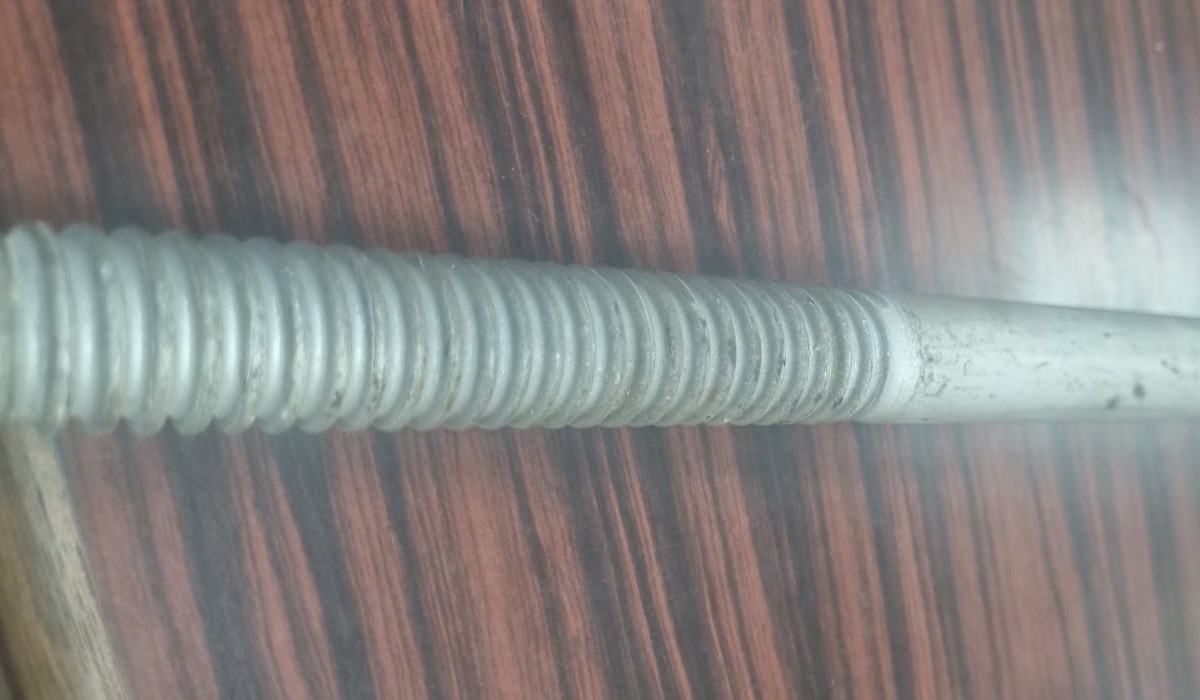
- A segment bolt is made to its socket. It screws into a socket cast into the next segment, not into an ordinary nut. So the thread has to match that socket, and a drawing that shows a standard metric thread with a nut and washer needs to be checked before anything is made.
- The thread form comes from the design. Our first job was a round thread. Most of our segment bolts now use a coarse 5 mm pitch trapezoidal thread, which the trade often calls ACME. Our article on tunnel segment bolt thread forms explains the types and what a drawing must state.
- Read the mechanical properties, not just the class. "8.8" on a drawing is where the conversation starts. Elongation, yield and the galvanised finish decide how the bolt is actually made.
What we make today
Today we are manufacturers of tunnel segment bolts to drawing, normally in property class 8.8, and customised where the design calls for it: 8.8 with 15% elongation, or a 700 MPa grade with higher elongation. They are hot dip galvanised, with threads rolled on our own machines. Our segment bolts have been supplied for metro tunnel works.
That is how we became manufacturers of tunnel segment bolts: with a drawing, a thread nobody had given us a gauge for, and a die maker who told us where to begin.
Have a segment drawing, or a socket thread detail you want checked?
Send it to us on WhatsApp and we will confirm the thread and properties before we quote.
Previous: Chapter 1, How we became high tensile fastener manufacturers in Ludhiana. Next Monday, Chapter 3: How we started making CSK bolts. See all articles on our blog.